We are told to do resistance training two to three times a week – but what does that mean exactly?


Whenever you see the World Health Organisation or a country that has physical activity guidelines or more recently 24-hour movement guidelines which often include physical activity, sleep and sedentary behaviour, they rarely go into detail. As I mentioned in last month’s blog, the new Australian 24-hour movement guidelines recommend older adults participate in muscle-strengthening exercises on 2 or more days per week. This is a really good start, but how does someone without a background in exercise work out exactly what that means!

There are of course options. You can find an exercise specialist, which if you have chronic conditions or a disability, it would be worth doing this. In Australia the exercise experts in this would be Clinical Exercise Physiologists. Personal Trainers (PTs) don’t need a degree and they are better suited to adults wanting one on one training who do not have health issues. Exercise Scientists have a three-year degree and their course prepares them to work with kids through to older adults without specific health conditions. Whereas Clinical Exercise Physiologists learn to work with people with many chronic conditions such as cardiovascular disease, respiratory, chronic renal, metabolic and neurological conditions or musculoskeletal pain, mental health or cancer. That is one option and you should be taken through an individualised program that is directly targeted at your strengths and weaknesses and helps you to improve your physical function and fitness. This is the best option possible. However, I also understand not everyone in today’s economic climate can afford to do this or likes going into clinics or gymnasiums.
Another option could be that you find something online. The only issue with this is you need to make sure it is right for you and you won’t get injured doing it. There are many people out there promoting themselves online and suggesting they know a lot about exercise, but they have no background in what is evidence-based and will benefit you and what isn’t.
So what can you look for that is evidence-based resistance or strength training?
These are the general parameters. You want to be doing strength training at least two days a week (you might even choose three days), preferrable on two non-consecutive days, this way your muscles get a chance to recover before you work them again.
In one session you would do 8-10 different exercises. You might decide to do total body on one day, lower body on another and upper body on the third if you are going three days a week. If you’re only doing two days a week you may decide on total body for your 8-10 exercises (this means working lower and upper body in the one session) on both days, or lower body on one day and upper body on the other. If you do the same thing over and over for a very long time your body gets used to it and you don’t gain as much benefit. Changing things up regularly, including the exercises, parts of the body you are working etc will keep your body and mind from getting into a rut and going through the motions. It is better to add variation, this will help you to continue building your strength and also not get bored.

For each exercise try and complete 8-12 repetitions (often called reps) and on the final repetition whether it is number 8 or number 10 or 12 you should be finding it really challenging. For older adults you might consider 10-15 repetitions and find it challenging by the 15th repetition, meaning you are lifting lighter weights but going for longer. Once you find those repetitions are starting to get easier you can increase the weight by 2-10%. For example, if you are lifting 10 kilos then you would increase it to 11 kilograms. You may even find doing something like a squat which doesn’t require any weight (apart from your body weight) is enough at the beginning, but over time you will add weight (which you can hold) to make it more challenging. You might find every fortnight or month you need to increase the weight, it all depends on how you are going. It is really important to listen to your body and when you are finding it easy, increase the weight and challenge yourself again.
The evidence also suggests you start with doing one set. This simply means that you do all of the 8-10 exercises, e.g. push-ups is one exercise, you do the 8-12 repetitions or 10-15 if you or doing lighter weights and only do each exercise once (that is one set). Then you build up to doing each exercise twice, which is two sets, but between each exercise or set make sure you have between 1-3 minutes of rest. This gives your body a little time to recover so that you can then work hard again which lowers your risk of injury.

Let’s recap!
You are looking at 8-10 exercises per session. You do each exercise between 8-12 or 12-15 times (repetitions), another example is doing 12 bicep curls. Then over time as you improve and get stronger you repeat doing the bicep curls 12-15 times (this means you have completed two sets) and then progress to doing 12-15 repetitions three times with 1-3 minutes rest between each set.
How do you work out which weight you start with on each exercise? This is definitely where exercise specialists can help you. The evidence says you should start at 50% and progress to 70-85% of 1RM. 1RM stands for One-Repetition Maximum, which is the maximum amount of weight you can lift for a single, full-range repetition of a specific exercise. For example, you want to do bicep curls as one of your exercises, to know where to start you would choose a weight where you can only lift, with correct form (doing the exercise properly, not using other parts of your body or momentum because the weight is too heavy) one bicep curl. Let’s say you could do one bicep curl with good form but cannot do anymore and that was using 10kg dumbbells. Then your 50% of RM1 will be 5kgs. That is the weight you would start with, doing your 8-12 or 3-4kgs and 10-15 repetitions for one set, and then progress from there. As it becomes easier over time you increase the sets, then increase the weight after getting to three sets, 2-3 times a week.
It is good to try and work over the week all of the major muscle groups such as your legs, hips, back, chest, shoulders, arms and core (i.e. trunk). It is recommended that you start with large muscle group exercises (e.g. squats, sit-to-stand, rows, chest press, step ups) before smaller, single joint exercises (e.g. bicep curls, triceps extensions). It’s also good to do some functional movements such as up and down stairs or carrying things with weight in them.

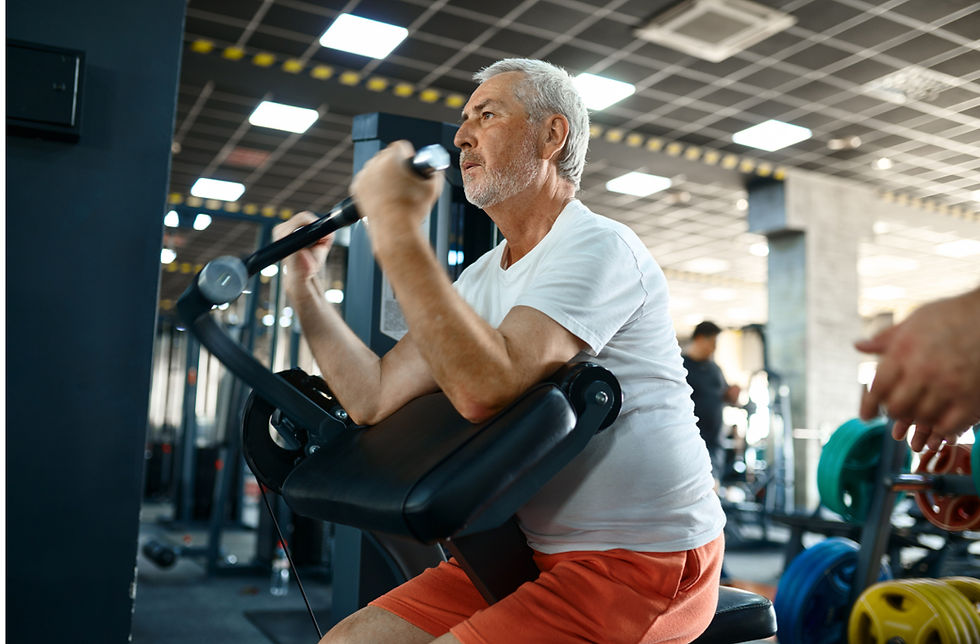
You can go to the gym and use the machines, but you can also use free weights at home, resistance bands, your body weight or medicine balls. There really are many options available. If you are doing things at home though, please make sure you use correct technique while doing each exercise. If you need to use body momentum to get through an exercise it usually means you are lifting weights that are too heavy for you and this can lead to injury, which we are all trying to avoid.
Also, it is really important to remember to warm up and cool down before and after each session. Ten minutes is enough and it’s about getting your body moving, getting the blood and oxygen pumping, so walking aiming for fast walking, or getting on a bike works well. Then do some stretches of the major muscle groups you are going to use. Your cool down can be a slow walk or cycle and then some stretches, again of the muscles you used a lot or where you are feeling tight as well.
One of the biggest things to remember though is if you are starting this for the first time in years, that afternoon or over the next 2-3 days you are likely going to be sore. This is called Delayed Onset Muscle Soreness or what we call DOMS. This is very normal and just means you are starting to use muscles you haven’t done for a while or you are putting them under more stress than they are used to. This is actually a good thing and if you do feel DOMS be pleased because it means you are challenging yourself. It will go away, you just need to hang in there.

As always, if you are doing strength or resistance training already just keep going and make sure you are challenging yourself over time and adding variety in
If you like the idea of going to a clinic or gym and working with a professional try and find a clinical exercise physiologist or equivalent in your area
There is also the option of group classes too, in Western Australia for over 50s there are centres that run a program called Strength for Life, which includes strength and balance exercises and a social occasion like coffee or tea at the end. There is likely to be something like this in your area, if you’re a sociable person this could be for you
I work out at home in my garage because that suits me (we have a small house too, so the garage works well), I have dumbbells of all different weight and also a few kettlebells of different weight too. We also use resistance bands, which work well. I have DOMS today from lifting heavier than usual weights, it’s annoying, but good to know I am getting stronger, so I just deal with it for a day or two
If you don’t want to start with any weights, that’s ok. There are lots of exercises you can do that only use your body weight, they are free because no equipment is needed. Exercises like squats, lunges, calf raises, sit ups, oblique work, push ups on knees, on hands and feet, or against the wall, triceps extension on the ground or on a table
Choose exercises that mimic your tasks of daily living.
Here it is again:
Warm up – 10 minutes, do some fast walking, cycling etc (often called cardio or aerobic activity) and some stretches, then do 8-10 exercises (choose all lower body, all upper body or a mix of upper and lower body), do these for 8-12 reps (or 10-15 reps if going lighter), work up from starting at one set of each exercise to 3 sets, having 1-3 minutes rest between each set and exercise. Progress the weight or exercises as they are getting easier (every 2-4 weeks but if you need longer then go for longer). Do a cool down, slower walking and stretches. Repeat 2-3 times per week.
Live the good life!
References
Fragala, M. S., Cadore, E. L., Dorgo, S., Izquierdo, M., Kraemer, W. J., Peterson, M. D., & Ryan, E. D. (2019). Resistance training for older adults: Position statement from the National Strength and Conditioning Association. Journal of Strength and Conditioning Research, 33(8), 2019–2052. https://doi.org/10.1519/JSC.0000000000003230


Comments